

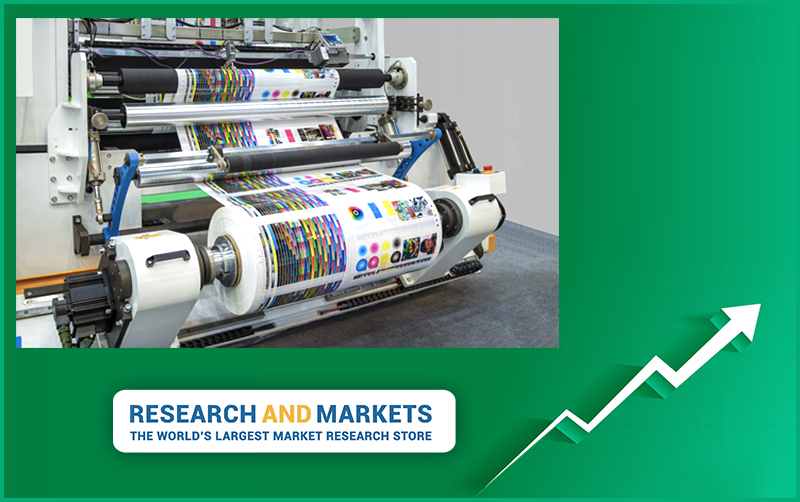
$23 Billion Roll-to-Roll Printing Market Outlook, 2030: ResearchAndMarkets
05 January 2026: The roll-to-roll printing market grew from USD 14.26 billion in 2024 to USD 15.41 billion in 2025, and is projected to expand at a CAGR of 8.35%, reaching USD 23.09 billion by 2030. Multiple industries are adopting this continuous substrate technology for flexible electronics, smart packaging, and renewable energy components.
Offering: Printers, rollers, contract printing, support & maintenance, software solutions
Printing Technologies: Flexographic, gravure, inkjet, offset systems
Material Types: Conductive inks-carbon-based, copper-based, silver-based and dielectric inks
Substrates including ceramics, fabric, metal foils, paper, PET film, polyethylene film, polyimide film
Application Areas: E-paper, flexible LCD panels, OLED displays, TFT displays, flexible circuit boards, printed batteries, sensors, RFID and smart labels, anti-counterfeit and barrier packaging, interactive QR/NFC-enabled packaging, PEM fuel cell membranes, dye-sensitized, organic and perovskite photovoltaics, textile printing
End User Industries: Aerospace & defense, automotive, construction & architecture, consumer electronics, healthcare
Regional Coverage: North America (United States, Canada, Mexico), Latin America (Brazil, Argentina, Chile, Colombia, Peru), Europe (United Kingdom, Germany, France, Russia, Italy, Spain, Netherlands, Sweden, Poland, Switzerland), Middle East (UAE, Saudi Arabia, Qatar, Turkey, Israel), Africa (South Africa, Nigeria, Egypt, Kenya), Asia-Pacific (China, India, Japan, Australia, South Korea, Indonesia, Thailand, Malaysia, Singapore, Taiwan).
Key Takeaways for Senior Decision-Makers …..
– Roll-to-roll printing supports continuous substrate processing, reshaping manufacturing paradigms in flexible electronics and interactive packaging.
– Rapid advances in material innovation-such as conductive polymers and specialty substrates-are driving product development for resilient, lightweight electronic components.
– Automated monitoring and software analytics enhance production throughput and enable data-driven quality improvements, optimizing operational efficiency.
– Strategic collaborations across the value chain, with ink developers and equipment OEMs, reduce development risks and accelerate commercialization cycles.
– OEMs leveraging modular equipment, new ink chemistries, and digital process control systems are better positioned to respond to evolving regulatory and market requirements.
– Segment diversity-from displays and printed circuits to energy applications and healthcare-provides a broad platform for targeted innovation and risk mitigation.
https://www.researchandmarkets.com/r/7l09zq