

Get future ready – three ways digital inkjet technology will power success: Tim Taylor
29 May 2025: Tim Taylor, Director Inkjet Production Solutions, Global Marketing, Ricoh talks about three ways digital inkjet technology will power success in coming time.
In the 40 years that I have worked in the printing industry, a succession of global developments (both economic and technical) have presented print providers with more than their share of challenges. With each financial crisis or technological revolution, the most agile have thrived by adopting innovations that have offered both cost savings and new business opportunities.
Today, we all face new operational challenges because of costs that continue to rise, a shortage of skilled workers, and an ‘on demand’ culture that makes 24 hour delivery the norm. At the same time, evolving government regulations, political and market volatility, and the looming threat of tariffs are adding layers of uncertainty and risk.
This is an environment in which the new levels of automation and flexibility offered by the latest generation of inkjet presses can help you to react to the external factors that are out of your control as well as creating new opportunities for how your clients view and use print.
This is set to continue, especially in the field of graphic arts for short run commercial print and highly targeted customer communications where three key capabilities, that all have automation at their core, are encouraging operations to add inkjet to their analogue facilities:
1 Automation to maintain quality in real time
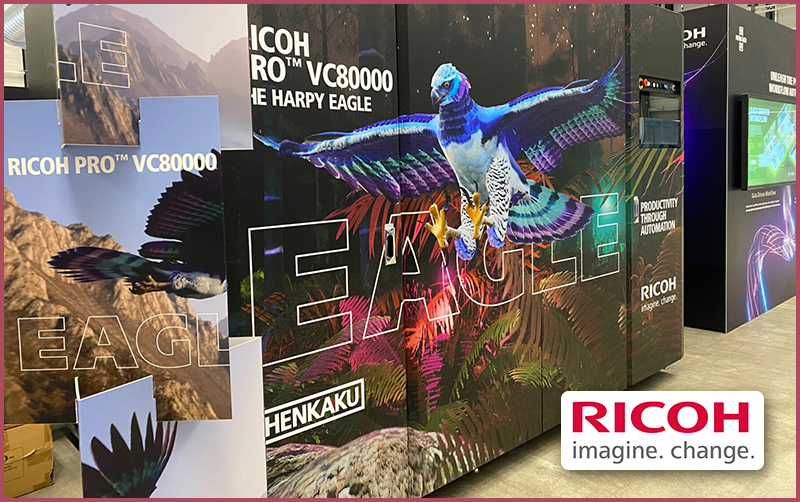
The quality of inkjet on coated papers has improved significantly over recent years but production efficiencies have been compromised by concerns about the potential for variation. By embracing intelligent automation the RICOH Pro™ VC80000 high speed inkjet press is able to monitor and adapt using real time data allowing Print Service Providers (PSPs) to automate print workflows and drive continuous production. RICOH’s Pro Automation Suite streamlines production by adjusting front to back and colour to colour registration as well as maintaining colour density from page to page. In addition, real time jetout compensation and correction means the press can guarantee output quality without production needing to stop.
2 Automation to ease staffing challenges
The availability of skilled staff as well as the increasing cost of employment means that there is a focus on labour reduction in all businesses. In Ricoh’s most recent generation of inkjet printers, a Smart Start feature has been introduced to remove time consuming press calibration and makeready tasks such as head checking and any necessary cleaning. Not only can this be scheduled to take place before the start of a working day, it can also be used at any point during the day if a new job or paper requires maintenance to the press. This completely automatic operation enables staff to focus on other value adding areas. The topic is discussed further here. Highly automated systems are easier to use, faster to set up, enable greater uptime, and enhance production capacity. They also reduce dependency on individual skill sets and subjective interpretation as predefined colour standards are set automatically.
3 Automation used to improve performance through analytics
Measuring is essential to improving understanding and performance and print production is no different.Monitoring a multitude of data points for maintenance and early identification of potential issues avoids costly downtime and the more data that is collected, the more it can be used to improve future performance. RICOH Predictive Insight™, which was first introduced on the Pro VC80000, provides data driven insights and performance optimisation through the data that it automatically collects. Its data collection and presentation capabilities monitor the effectiveness of operations to help optimise hardware uptime and throughput while minimising maintenance cycle interruptions. The automatic gathering of data from workflow solutions, printing and finishing devices, formulates insights to maximise return on investment, aids data driven investment decision making, and improves overall business outcomes. These capabilities will continue to expand as we move into an increasingly integrated world.
While we might all be facing a challenging business environment, agile, flexible, and highly automated digital production systems are vital to being able to adapt to the changing market and making the most of all the opportunities that it presents.
www.ricoh-europe.com