



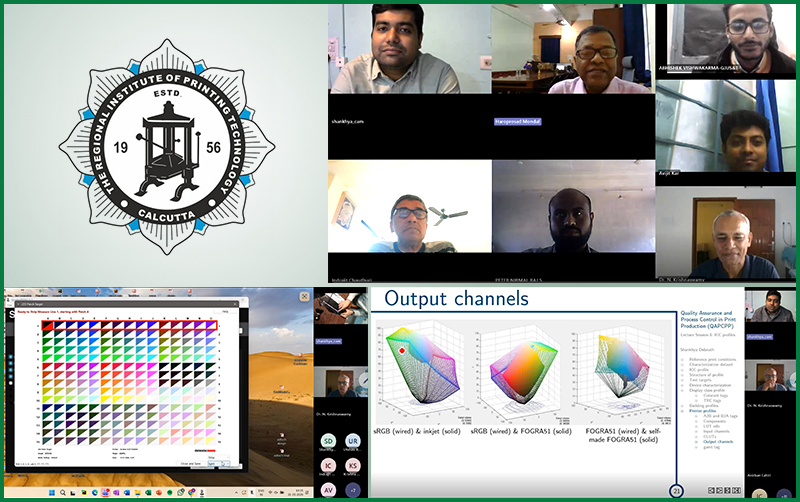
RIPT Kolkata organizes 3-day Online STTP – Focused on “Quality Assurance and Process Control in Print Production”
30 January 2026: Regional Institute of Printing Technology, Kolkata, a Government of West Bengal polytechnic institute, conducted a first-of-its-kind three-day online Short-Term Training Program on “Quality Assurance and Process Control in Print Production” from 19-21 January 2026. It was positioned as an answer to a long-felt need in India’s printing ecosystem – where expectations around consistency, repeatability and customer satisfaction are rising, but structured training opportunities in quality-focused workflows remain limited.
The program was conceived after observing a common pattern across many print setups: when deadlines are tight and job variations are frequent, quality often becomes dependent on individual experience and visual judgement, leading to avoidable rework, wastage and uneven results. In an era where print is increasingly tied to branding, packaging compliance and multi-location production, such inconsistency can directly affect credibility and cost.
The background to the initiative lies in the industry’s ongoing transition toward faster, more digitised production environments. As workflows become more automated and data-driven, the need to understand how and why variations occur-across materials, machines, operators and job conditions-has become more pressing.
While print technology has advanced, the availability of dedicated platforms for training professionals and researchers on practical quality assurance and process control has not grown at the same pace. This gap motivated the institute to create a focused, time-bound program that could deliver both clarity and confidence to working professionals, decision-makers, researchers and educators without requiring long-term leave from work or travel.
The programme was inaugurated by Jayanta Banerjee, Director, Technical Education & Training, Government of West Bengal, in the presence of Haroprosad Mondal, Principal-in-Charge, RIPT, and faculty members of the department. The program coordinator for this STTP was Shankhya Debnath, Lecturer & HoD, Dept of Printing Technology, RIPT.
The effectiveness of the program was reflected in both the diversity and the engagement level of participants. A total of 20 participants joined from across India, including 9 industry professionals, 6 industry leaders and 5 academicians. This mix mattered, because quality improvement in print production is not the responsibility of a single role: leaders decide investment and policy, professionals execute daily control and troubleshooting, and academicians train future talent.
The presence of all three groups will allow discussions to move beyond “what should ideally happen” to “what can realistically be implemented”, and will help participants learn from one another’s constraints and best practices. Geographically, participants represented seven states, led by West Bengal (8) and Maharashtra (4), with Uttar Pradesh, Tamil Nadu and Telangana contributing two participants each, and Kerala and Assam one each.
The spread showed that the demand for quality-led approaches is shared across different print clusters and educational ecosystems, not limited to one region. For an online program, this reach is significant, demonstrating that accessible digital delivery can connect professionals and educators who otherwise may not be able to attend specialised training.
Importantly, the program’s value was framed not as an abstract academic exercise, but as a direct response to day-to-day production realities. The sessions aim to help participants build a practical mindset: how to reduce variation, how to interpret quality deviations, how to maintain repeatability over time, and how to develop a simple, disciplined routine for checking and control. Improving quality is not only about “better-looking prints”, but also about business outcomes – fewer press stops, fewer customer complaints, reduced material waste, smoother approvals and stronger trust with clients.
For industry participants, the program aimed to strengthen the ability to set up more stable workflows, improve consistency across jobs, and reduce dependence on last-minute corrections. For academic participants, it offered updated industry-relevant knowledge that can be carried into classroom teaching, lab practices and student projects-helping align education with current professional expectations.
At the institutional level, the program is expected to strengthen industry – academia linkage and create a foundation for future refresher programs, collaborative projects and advisory support focused on print quality and process improvement.
Shankhya Debnath – shankhya@riptkolkata.org
