

India and the United Kingdom Comprehensive Economic and Trade Agreement (CETA) to come in Force from 15th July 2026
19 June 2026: In a major stride for India’s global economic engagement, the India and United Kingdom have announced that the Comprehensive Economic and Trade Agreement (CETA) will enter into force on 15th July 2026, marking a new phase in the country’s economic diplomacy. Simultaneously, the Agreement on Social Security-also referred to as the Double Contribution Convention (DCC)-will also come into effect on 15th July 2026, reinforcing the mobility and competitiveness of Indian professionals in the United Kingdom.
Following the successful completion of internal procedures and ratifications by both governments, the agreements will formally enter into force on 15th July 2026. Aligned with the national vision of “Viksit Bharat 2047,” this milestone will operationalize a highly sophisticated, well-balanced economic framework that translates policy into active daily commerce with a major global economy.
The groundwork for this historic agreement was laid in May 2021 through the Enhanced Trade Partnership and the adoption of the India-UK Roadmap 2030, which set the goal of elevating bilateral ties to a Comprehensive Strategic Partnership and doubling trade to USD 100 billion by 2030.
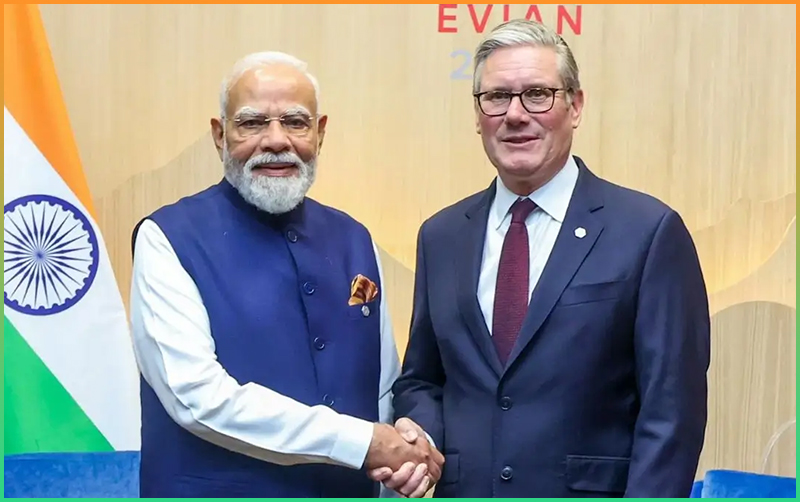
Following fourteen intensive rounds of negotiations, CETA was concluded on 6 May 2025. The agreement was officially signed on 24 July 2025 in London by India’s Union Minister of Commerce and Industry, Piyush Goyal, and the UK’s Secretary of State for Business and Trade, Jonathan Reynolds, in the presence of Prime Minister Narendra Modi and British Prime Minister Keir Starmer.
India’s Commerce & Industry Minister, Piyush Goyal, said “Simultaneous enforcement of the CETA and the Double Contribution Convention on 15th July 2026 will open up significant new opportunities for India’s exports. By securing immediate duty-free access on 99% of our tariff lines, we have systematically dismantled long-standing tariff walls. This will effectively level the playing field, allowing our textiles, leather, marine, engineering, and processed food sectors to compete with no disadvantage and supply their world class products.
A Next-Generation Trade Framework
Comprising 30 chapters, CETA establishes a new paradigm for next-generation trade pacts, directly supporting India’s “Viksit Bharat 2047” vision. Beyond traditional tariff-cutting, the agreement modernizes bilateral engagement by integrating traditional goods and services with advanced disciplines like digital trade, telecommunications, financial services, intellectual property and-for the first time bilaterally-government procurement. It also embeds forward-looking chapters on innovation, SMEs, sustainability, and transparency to ensure inclusive growth. Ultimately, this framework is engineered to secure critical supply chains, accelerate technological collaboration and establish a transparent and rules-based benchmark.
Key Economic Gains
The operationalization of the Comprehensive Economic Trade Agreement (CETA) and the simultaneous Double Contribution Convention (DCC) will mark a structural transformation in India’s global trade architecture. This comprehensive framework leverages India’s manufacturing prowess, service capabilities, and grassroots production directly into one of the world’s premier consumer arenas.
Transformational Market Access for Indian Exports
With the entry into force, Indian exporters will benefit from the complete elimination of UK tariffs across several key sectors. Tariffs of up to 70% on processed food products, up to 21.5% on marine products, up to 18% on engineering goods and auto components, up to 16% on leather and footwear products, up to 12% on textiles and clothing, and up to 8% on chemicals and pharmaceutical products will be reduced to zero.
This immediate duty-free window injects immense pricing power into the engine rooms of Indian manufacturing, allowing traditional artisans, large-scale factories, and regional industrial hubs to compete entirely on merit from day one of implementation. At the same time, India has protected sensitive sectors including dairy products, cereals, millets, edible oils, oilseeds, apples and several vegetable products.
Agreement also provides predictable mobility pathways for ….
– Business Visitors
– Intra-Corporate Transferees
– Contractual Service Suppliers
– Independent Professionals
– Investors
In a first-of-its-kind arrangement, 1,800 Indian chefs, yoga instructors and classical musicians will be able to access dedicated mobility opportunities annually under the Agreement.
https://www.commerce.gov.in/#/international-trade/trade-agreements/india-united-kingdom-comprehensive-economic-and-trade-agreement