
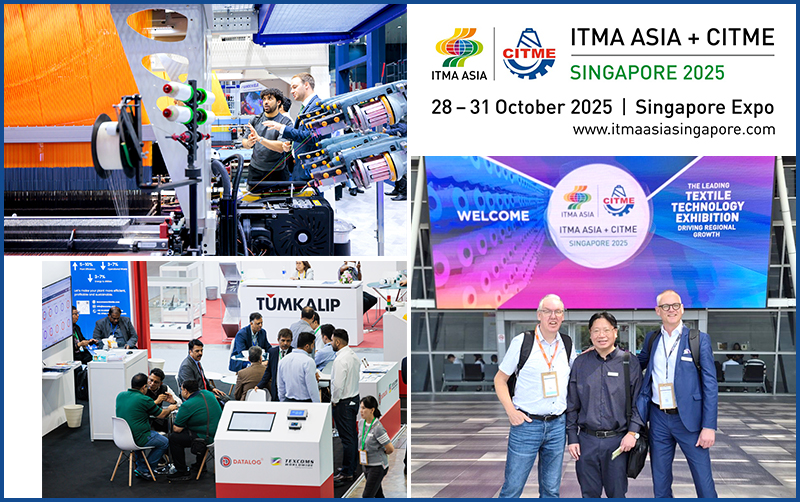
ITMA Asia + CITME 2025 Singapore Makes a Strong Impact: Dirk Oelschläger
27 November 2025: Dirk Oelschläger, Regional Sales Director, KISSEL + WOLF, analyses and provides an overview of the event while highlighting key initiatives by some of the exhibitors.
The ITMA Asia + CITME 2025 Singapore trade fair was very well attended, which was certainly due in part to Singapore’s excellent infrastructure. Most visitors came from across Asia and the Indian subcontinent.
The printing technology section, located in Hall 6, was well represented with 100+ exhibitors. Alongside established names like SPGPrints, Zimmer and MHMS, many exhibitors came from Asia and India. The main focus areas were digitalization and automation, advancements in digital textile printing, color management, process control and sustainability.
Visitors could explore a wide range of innovative digital printing solutions – from single-pass systems and DTF to new ink formulations and hybrid technologies. For example, Atexco (www.atexco.com) showcased its “VEGA ONE” – a super high- speed single-pass digital textile printer that can optionally be connected to a conventional rotary screen printing line, enabling digital overprinting on textiles. With speeds of up to 4,800 m/hour and a maximum rate of 100 m/min, it was truly impressive.
Bihong (www.bhprinter.com) presented a combination of an oval screen printing machine and a digital printer (“Q-Jet”), offering a production capacity of 600 pcs/hour, along with the BH-CTS 300C, a modern blue-ray laser CTS system capable of resolving lines as fine as 40 microns.
The standout presence in Hall 6 was SPGPrints (www.spgprints.com), which had the largest booth and an extensive range of machinery on display. Alongside the “Eucalyptus” and “Teak 1.2” rotary printing systems, SPGPrints introduced the new cost-optimized “Larch” laser engraver and demonstrated the “Jasmine” scanning digital printer. The company also highlighted solutions to minimize nickel abrasion during printing, such as internally coated screens and lacquered or polyurethane- tipped squeegees.
Noteworthy among the first-time exhibitors at the event was Dyne Chemicals (https://dyne-chemicals.com/) showcased the company’s innovation and performance-focused product range. Their sustainable, cost-effective and high-performance solutions drew the attention of many visitors, further strengthening its position as a next-gen, globally scalable textile chemical brand.
Their vision to revolutionize the textile industry through innovative textile chemicals, setting new standards in quality and reliability, and empowering global customers with environmentally responsible solutions that lead the future, resonated with the environment-friendly approach of visitors and exhibitors alike.
Equally impressive was Zimmer Austria (www.zimmer-austria.com), showcasing a duplex rotary printing machine designed for double-sided textile printing. Other highlights included the Colaris digital printing system and carpet printing technologies. According to CEO Horst Ros, the Asian markets – particularly India and China – are especially important for the Klagenfurt-based company.
The world’s second-largest textile market, Bangladesh, is showing a slight decline, while in Europe, new business is limited. However, there has been investment in camouflage printing, likely linked to increased military demand in wake of the Ukraine-Russia conflict. Flatbed printing machine manufacturing, he noted, has become increasingly rare.
For Markus Hauser, Managing Director of Tyrolean machine manufacturer MHMS (www.mhms.at), India is also one of the key markets. The country’s rapidly growing textile industry is not only serving its massive domestic market but is also investing heavily in high-quality products for export.
Harsh Shah, Managing Director of Embee Group (www.embeeindia.com), confirmed India’s strong growth trajectory. The long-established company from Ahmedabad focuses on complete packages for textile rotary printing systems.
Similarly, Amberish Dalal, Managing Director of ARC India, emphasized the importance of both the Indian and Bangladeshi textile markets. With a wide portfolio of chemical products for screen printing and textile applications – including emulsions and adhesives for screen engraving – the company is well positioned for continued growth.
A major topic at ITMA was DTF (Direct-to-Film) printing. Kornit (www.kornit.com) introduced the MAX DTF, a powderless direct-to-film system called Max Transfer, which integrates with Kornit’s Atlas Max DTG printers. It offers a faster, cleaner and more sustainable alternative to traditional DTF printing by transferring prints via film – heat-pressed onto garments without messy powder adhesives. The result: high- quality, durable prints with a soft hand feel.
DCC (www.groupdcc.com) presented the NeoFlex, a fully integrated, high-speed DTF ecosystem that unites printer, dryer, inks, films, powder and SmartRIP software into one seamless system.
All in all, the event provided an excellent industry convergence point and now the focus shifts to the next year when ITMA ASIA + CITME 2026 will beckon everyone from November 20-24 to Shanghai, China for the forthcoming edition.
Dirk.Oelschlaeger@kiwo.de