



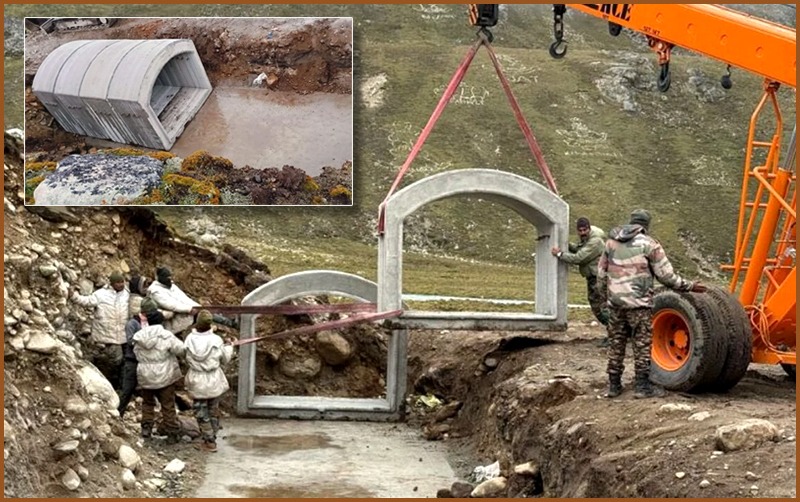
Indian Army Used 3D Concrete Printing in Leh and Sikkim
24 November 2026: The Indian Army used 3D concrete printing to build a bunker in Leh, Ladakh, in a project announced in April 2025. Its Trishakti Corps used the technology in Sikkim that December. The two cases show that teams can bring the printer to a mountain construction site and produce structures there.
Project PRABAL in Leh: 14 hours of printing
Simpliforge Creations and the Indian Institute of Technology Hyderabad (IIT Hyderabad) worked with the Indian Army on the Leh bunker under Project PRABAL. Simpliforge announced the completed structure on 18 April 2025 and put the elevation at about 11,000 feet. PRABAL stands for Portable Robotic Printer for Printing Bunkers and Accessories, according to a release reported by Asian News International (ANI).
Simpliforge reported 14 hours of printing within a five-day build. For anyone comparing construction methods, the five-day figure is the one to put alongside another project’s build time. The shorter figure measures printing alone. Neither number describes a standard schedule for mountain construction.
Where 3D concrete printing went next
The Indian Army’s Trishakti Corps put on-site concrete printing to use in Sikkim and adjoining areas, ANI reported on 6 December 2025, citing a release. The report identifies bunkers, sentry posts and other protective structures as applications and says printed structures underwent ballistic trials.
The release described the printer as portable. It cited the ability to use local materials and adapt designs to individual sites as advantages of printing on location.
Why the concrete matters as much as the printer
A construction printer builds up concrete in successive layers, as Simpliforge explains. In Leh, the team used locally sourced materials. K.V.L. Subramaniam, the IIT Hyderabad professor who led the work, said his team tested a concrete mix suited to local aggregates and site conditions. The New Indian Express reported that the testing included analysis of local sand and aggregate.
The conditions affected more than the concrete. In Simpliforge’s April announcement, chief executive Dhruv Gandhi said the thin air reduced power efficiency and affected the people working on site. He also pointed to low humidity and strong ultraviolet radiation as challenges for the material.
Arun Krishnan, a doctoral scholar at IIT Hyderabad at the time of the announcement, said Project PRABAL began during his master’s studies. The Leh build brought the institute’s materials research and Simpliforge’s printing work together on site.
Concrete printing outside defence
Concrete printing has civilian applications at different scales. Simpliforge lists wall façades and outdoor furniture among its uses, while IIT Hyderabad’s research showcase includes a 3D-printed bridge on its campus.
Simpliforge describes a process that can make individual building elements as well as larger structures. Across such different jobs, a print time tells readers more when it comes with two details: what the printer made and how long the whole build took.

Sorry, the comment form is closed at this time.