
India’s Industrial Printing Momentum: Reflections from the SGAI Seminar in Mumbai: Piotr Rogacki
29 May 2026: Piotr Rogacki, Ph.D. Eng., Head of the Management Board, Nittoku Europe, shares key takeaways and observations from his recent ten-day India visit.
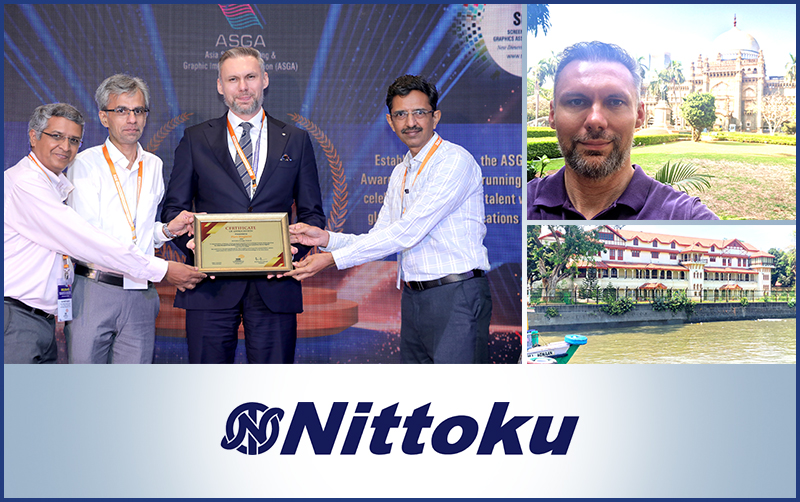
My first visit to India was connected with the SGAI full-day technology seminar held in Mumbai on 17 April 2026. I spent 10 days in the country, meeting companies, speaking with industry professionals and observing the market from close range. I arrived with curiosity. I left with a very strong impression that India will play an increasingly important role in the future development of industrial screen printing.
The seminar, organised by the Screenprinting & Graphics Association of India, was a very well-prepared and highly professional event. Around 100 industry participants attended, representing a strong cross-section of the Indian screen printing community.
What impressed me immediately was not only the number of people in the room, but the quality of the audience. These were experienced, technically oriented professionals, interested not in general marketing messages, but in real production challenges, practical solutions and future opportunities.
For me, this was one of the strongest values of the conference.
The discussions were direct, concrete and very professional. The participants asked about real applications, real problems and real limitations in industrial printing. There was interest in registration accuracy, long production cycles, stencil life, ink deposit consistency, automation, process stability and total production cost. These are exactly the topics that define the future of high-end screen printing.
The Nittoku presentation was titled “High-Accuracy Printing in Long Production Cycles.” I focused on situations where a printing job starts perfectly, but after a few thousand prints the registration begins to move, fine lines lose sharpness, ink deposit becomes less consistent and operators are forced to compensate. In many industrial applications, the real challenge is not to make one perfect print. The challenge is to keep the process stable over a long production run.
After the presentation and during the breaks, I had many valuable conversations with participants from different areas of industrial printing, including automotive decals, automotive glass, packaging and other demanding applications. The level of these discussions confirmed to me that the Indian market is not only growing in volume. It is also developing technically.
This is why I believe that events such as the SGAI seminar are extremely valuable. Large exhibitions are still important, of course, but when we speak about high-end, complicated industrial applications, a focused technical seminar can be even more effective.
In such applications, success depends on understanding the problem deeply. It is not enough to show a product. We need time to discuss the customer’s process, the limitations, the failure points and the possible solutions. SGAI created exactly this type of platform: professional, focused and open for real interaction.
Two weeks after the seminar, I can say that the event still resonates. It has led to new contacts, new conversations and new discussions about applications, challenges and possible solutions. This is probably the best measure of success for a technical conference.
A good seminar does not end when the last presentation is finished. It continues through the relationships and technical discussions that follow.
One of the most memorable moments of the conference was the presentation by Kunal Gandhi, who showed figures indicating that the Indian screen printing market may double by 2030. From a European perspective, such numbers may sound ambitious. However, after spending 10 days in India, visiting companies and observing the level of economic activity, I find this forecast realistic.
India’s growth is often described through macroeconomic data, but what impressed me most was something more practical: the energy and activity of people.
I had already formed a general impression of Indian work ethic, curiosity and professionalism through my work as an academic teacher at Poznan University of Technology, where I teach international groups of students, including many students from India. However, what I saw and experienced in India exceeded my expectations and allowed me to understand these qualities much more deeply.
I saw strong work ethic, entrepreneurial attitude and a clear willingness to develop. People are active, ambitious and open to learning. They are not waiting for the future; they are building it.
This energy is visible in the printing industry as well. India is moving from traditional applications toward more advanced and functional areas of screen printing. Industrial printing is becoming more demanding. Customers need higher accuracy, better repeatability, better process control and more stable production. These requirements create strong opportunities for companies that can bring technical knowledge, high-quality materials and reliable process support.
At the same time, India has something that is sometimes underestimated in international business: a very strong relationship culture. My impression is that Indian companies build long-term cooperation based on partnership and trust. This is not just a social element. It is a real business advantage. When trust is established, communication becomes faster, problems are discussed more openly and development can move quickly.
During my visit, I experienced exceptional hospitality and openness. Business meetings often became much more than formal discussions. They were opportunities to understand people, their companies, their ambitions and their way of thinking. I found this combination of professionalism and personal warmth very powerful. It creates a business environment in which technical cooperation can grow naturally.
For Nittoku, the SGAI seminar was an important opportunity to present our technical perspective and to better understand the Indian market. But personally, it was also a valuable learning experience. I saw a market with strong potential, strong people and a strong appetite for advanced industrial printing solutions.
My conclusion is clear: India should not be seen only as a large market. It should be seen as a strategic market and, even more importantly, as a partner market. The country has scale, ambition, technical curiosity and a strong relationship-based business culture. These qualities can accelerate the development of industrial screen printing in the coming years.
I would like to express my sincere appreciation to SGAI for organizing such a professional and meaningful event. The seminar created the right space for knowledge exchange, technical discussion and personal connection. For me, it was not only a successful conference. It was a memorable introduction to India and to the energy of its screen printing industry.
India is moving forward with confidence. After my first visit, I believe this confidence is fully justified.
About Piotr Rogacki ….
Piotr Rogacki is the Head of the Management Board of Nittoku Europe. He holds a PhD (Eng.) in Production Management and Quality Science and has been working in the industrial printing sector for over 23 years. He is also a lecturer at the Poznan University of Technology.
piotr.rogacki@nittokueurope.com