

AEPC Supports India’s USD1 Trillion Export Target, Seeks Apparel Policy Push
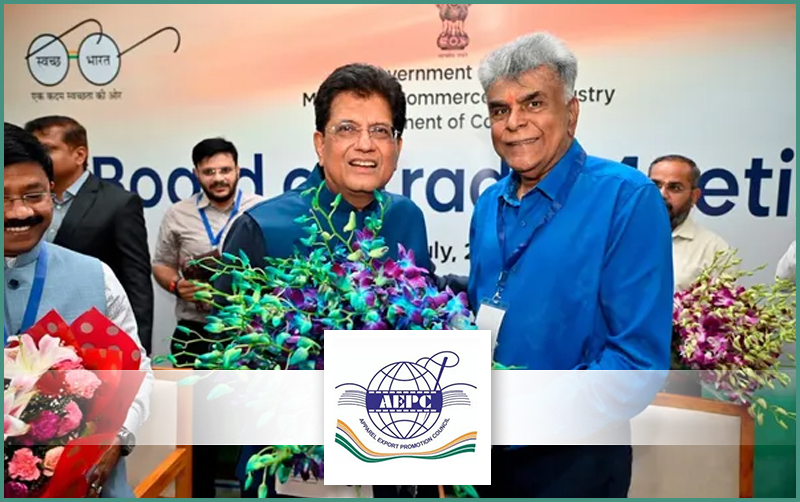
08 July 2026: The Apparel Export Promotion Council (AEPC) has backed India’s USD 1 trillion export target for FY 2026-27 and submitted policy proposals aimed at improving apparel export competitiveness, sustainability and manufacturing capacity. The proposals were presented at the Board of Trade meeting held in New Delhi on July 3, where Union Commerce and Industry Minister Piyush Goyal called for coordinated action by the Centre, States, industry bodies and exporters.
At a Glance ….
– Target: USD1 trillion in total exports in FY 2026-27
– Government split: Around USD530 billion in merchandise exports and USD470 billion in services exports
What the Board of Trade discussed
The Board of Trade, the Department of Commerce’s consultative platform, brought together State and Union Territory representatives, Export Promotion Councils, industry chambers and exporters. According to the Press Information Bureau, Goyal set a USD 1 trillion export target and said India closed FY 2025-26 with its highest-ever exports of USD 863 billion.
The government’s plan depends on stronger goods and services exports, wider use of Free Trade Agreements, better testing infrastructure, support for MSMEs and a 90-day export drive across 120 priority districts under the Districts as Export Hubs initiative.
AEPC’s response
AEPC Chairman Dr. A. Sakthivel welcomed the export target and said expanded market access through FTAs, along with continued policy support, can help the apparel sector contribute to the national goal. He also submitted proposals focused on cost competitiveness and easier compliance. AEPC has asked for the Interest Subvention Scheme benefit to be raised from 2.75% to 5%, with coverage extended to all exporters and the annual cap removed. It also sought relaxation of average export obligation norms under the EPCG scheme for exporters affected by market disruptions, especially those dependent on U.S. market.
Key apparel sector proposals
– AEPC’s recommendations include continuation of the RoSCTL scheme for at least three more years and extension of benefits to exporters operating under Advance Authorisation, Export Oriented Unit and Special Economic Zone schemes.
– The Council has also called for a dedicated Green Transformation Fund offering long-term soft loans for sustainability investments and ESG compliance. Another proposal is a Special Scheme for the Apparel Sector based on self-ratified input-output norms to simplify duty-free fabric imports and reduce compliance burden.
– Other asks include more support for worker hostels and affordable housing in apparel clusters, faster implementation of PM MITRA Parks with a focus on man-made fibre production, and mandatory Registration-cum-Membership Certificate for exporters seeking promotion scheme benefits.
Why it matters
India’s apparel exporters face rising compliance demands, pressure on margins and shifting sourcing patterns. If accepted, AEPC’s proposals could help exporters lower finance costs, meet buyer sustainability norms and improve speed in production clusters. The challenge will be converting policy asks into timely approvals before the FY 2026-27 export target window closes.