

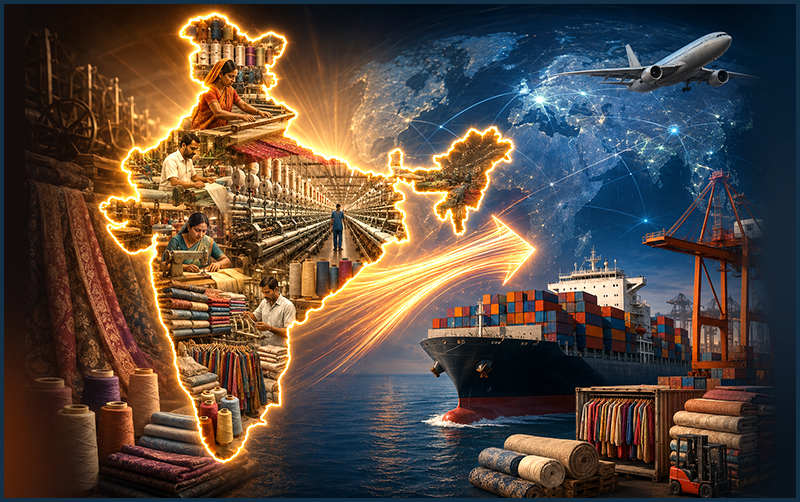
Government Targets $360 Billion Textile Industry and $100 Billion Exports by 2030
15 June 2026: India’s textile sector is being positioned as a key pillar of the Viksit Bharat 2047 mission, with the government targeting an increase in the industry’s size from $190 billion to $360 billion and a rise in textile exports from $37 billion to $100 billion by 2030, the Ministry of Textiles said during a recent press conference.
To support these objectives, the domestic textile market, currently valued at Rs.8.5 lakh crore, is projected to reach Rs 33 lakh crore by 2030. Fibre demand is also expected to increase from 14-15 million tonnes to 25 million tonnes, according to Textile Minister Giriraj Singh.
The Ministry highlighted the sector’s contribution to employment, noting that women account for more than 50 per cent of the workforce across textiles and handlooms.
Ministry Secretary Neelam Shami Rao said that over 75% of the approximately ten lakh people trained under the Samarth scheme over the past five years were women, with a placement rate of around 80%, indicating significant participation in formal industrial employment.
On infrastructure, the Secretary said seven PM MITRA Parks have been sanctioned and three have been inaugurated. Each park spans 1,000 to 2,000 acres and has already attracted investment proposals worth over Rs 50,000 crore. The Warangal PM MITRA Park, inaugurated by Prime Minister Modi last month, has commenced production and is exporting to global markets.
Officials also pointed to India’s emergence as the world’s second-largest PPE producer, describing the shift from near-total import dependence at the onset of COVID-19 as evidence of the country’s technical textile capabilities.
The Ministry said Indian manufacturers are expanding production in the Meditech and Autotech segments, including airbag fabrics, sutures, diapers, and hygiene products.
Separately, the Ministry outlined India’s focus on New Age Fibres, including milkweed, described as finer than pashmina and lighter than synthetic alternatives, along with bamboo mechanical fibre and banana fibre. Women from Self-Help Groups are being integrated as aggregators within the value chain.
The Ministry also noted that Europe’s increasing demand for sustainable fibre content in imports remains an important driver for the sector.
To achieve a 10% share of the global textile market by 2047, the Secretary said India would need to attract approximately $50 billion in investment over the next five years. India currently exports to 191 of the WTO’s 194 member countries, up from 537 districts ten more than last year.