



INDIAsize Charts Offer Indian Fit Reference as Label Standards Take Shape
16 September 2026: INDIAsize, the National Institute of Fashion Technology’s body-measurement initiative, has made Indian men’s and women’s size charts available online from 2 January 2026. The research gives India’s apparel industry a reference for better-fitting clothing, while national size-labelling standards remain under development rather than an adopted requirement.
What does INDIAsize measure?
According to NIFT’s official INDIAsize overview, the institute, under the Ministry of Textiles, collected measurements from 26,324 people aged 15 and above using 3D whole-body scanning. NIFT describes the sample as statistically representative of the Indian population.
The research produced 14 body-size charts for Indian males and 13 for Indian females. These are sets of charts, not a declaration that every brand must offer exactly 14 men’s sizes or 13 women’s sizes.
The official project portal says the study was completed in 2023. It lists scanning locations across New Delhi, Mumbai, Chennai, Hyderabad, Kolkata and Shillong. The later release of charts should therefore not be confused with the timing of the fieldwork.
Size charts are available; labelling rules are not final
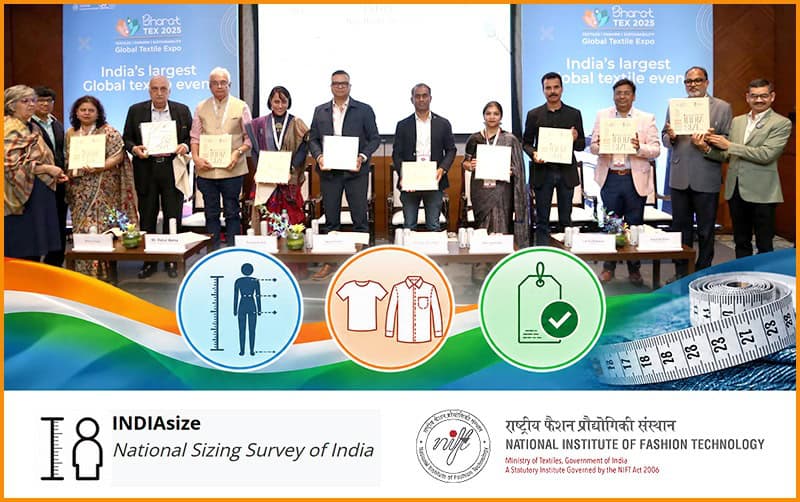
NIFT says an extract containing representative male and female charts launched at Bharat Tex 2025 on a pro-bono basis. Separately, NIFT describes an “IN Tag” size-identification system and says national standards derived from the database are under development by the Textiles Committee, Ministry of Textiles. For apparel businesses, that distinction matters: access to body-measurement data is not the same as a binding requirement to replace existing labels.
What could change for clothing buyers?
The project aims to address sizing disparities by giving manufacturers a reference based on Indian body measurements. If brands apply that reference consistently, shoppers could find it easier to compare size information across products.
Retailers are also exploring digital approaches to fit, including the MySize sizing technology plans previously reported by Screen Print India. Such tools and national body-size charts address related problems, but they are not interchangeable.
Better fit could reduce size-related exchanges and returns. However, the official sources reviewed do not provide measured reductions in returns, transport emissions or packaging waste attributable to INDIAsize.
What manufacturers and garment printers should watch
Body-size data offers a starting point for product development, not a complete garment specification. Manufacturers should assess the charts alongside their intended customers and product designs, rather than assume that a shared size reference makes finished garments identical.
That distinction also separates sizing research from design direction. NIFT’s Kalpa fashion forecast addresses future design choices; INDIAsize addresses the body measurements behind fit.
For screen printers, embroiderers and transfer suppliers, the practical recommendation is to retain garment-specific artwork placement checks. INDIAsize alone does not establish uniform print areas or dimensions across brands.
Size communication is also separate from colour consistency, the subject of the NIFT colour-management partnership. Both deserve attention during production planning, but neither replaces checks on the actual garment.


Sorry, the comment form is closed at this time.