



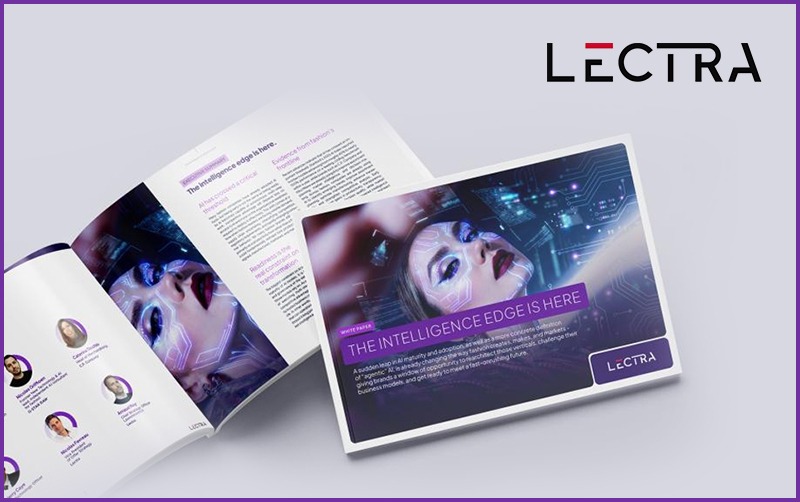
Lectra AI White Paper Puts Agentic AI at the Centre of Fashion
10 November 2026: The Lectra Observatory, which explores innovation in the fashion, furniture and automotive markets, published a white paper, The Intelligence Edge Is Here, in Paris on 22 October 2026. The Lectra AI white paper examines how a leap in artificial intelligence (AI) maturity is changing fashion, and notes that AI’s effectiveness depends on the quality of its data.
The report covers product creation, manufacturing, marketing, traceability and collaboration. It is the fifth Lectra Observatory white paper dedicated to fashion.
What does the Lectra AI white paper say?
The Lectra AI white paper says fashion has moved past using AI for isolated jobs such as content generation and trend forecasting. According to the release, AI connected to enterprise data, product information and business workflows can support decisions, automate complex processes and link teams across the value chain.
Maria Modroño, Chief Marketing and Communications Officer at Lectra, said the companies “that successfully combine AI with trusted data, deep industry expertise, and connected workflows will be best positioned to accelerate innovation, improve decision-making, and build lasting competitive advantage in an increasingly complex market.”
Why agentic AI is the report’s main theme
Agentic AI is the paper’s central idea. Lectra describes it as AI that can coordinate and execute multi-step workflows, so teams set objectives while software agents analyse information and move work between systems. Lectra calls AI readiness a data problem as much as a technology one. Readers following similar shifts can compare AI and 3D in fashion production.
Five areas where Lectra sees AI value
- Product creation: spotting trends, guiding design and assortment choices and shortening development cycles.
- Manufacturing: using production data to improve material use, planning and quality, and to cut waste.
- Marketing: reading consumer behaviour and campaign results to improve product visibility.
- Traceability: making supply-chain data easier to act on as sustainability rules and sourcing checks tighten.
- Collaboration: aligning teams around a shared source of truth across the product lifecycle.
The manufacturing point echoes work elsewhere in textile production, including sustainable digital textile printing.
Who contributed to the report?
Contributors include Ilaria Del Gaudio of KIKO Milano, Caterina Ticchio of C.P. Company, independent AI consultant Nicolas Griffioen, formerly of G-STAR RAW, and Ben Hanson, Editor-in-Chief of The Interline. Lectra executives Maximilien Abadie, Thierry Caye and Nicolas Favreau also took part, along with Arnaud Roy of Launchmetrics, a Lectra company.
The report incorporates perspectives from fashion executives, technology specialists and industry experts, highlighting practical opportunities for adopting AI across the sector.
Lectra also emphasises that human creativity, technical expertise and professional judgment will remain essential, with AI supporting rather than replacing skilled professionals.
As fashion companies face increasing pressure to improve sustainability, reduce costs and accelerate product development, Lectra believes the integration of AI, connected data and intelligent automation will play a critical role in shaping a more efficient, responsive and competitive global fashion industry.


Sorry, the comment form is closed at this time.