


GJUST Conference Examines AI and Robotics in Printing
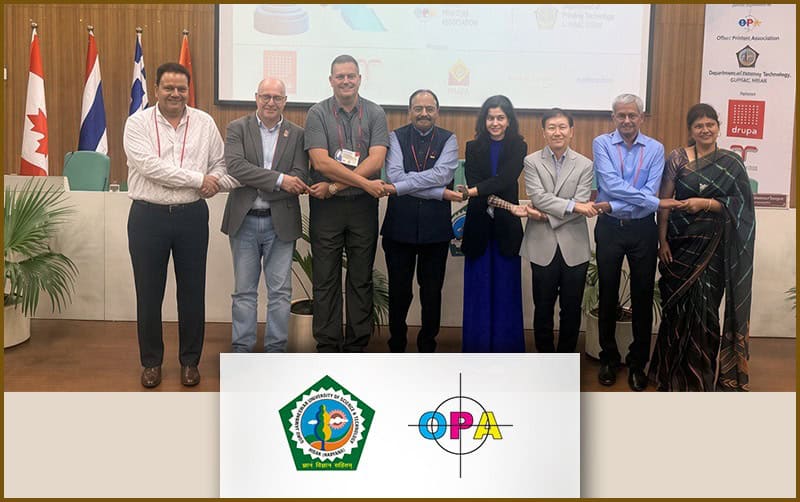
06 October 2026: Guru Jambheshwar University of Science and Technology (GJUST), Hisar, hosted an international conference on AI and robotics in printing and packaging from 24-26 September 2026. Speakers examined how printers can use automation to improve quality and reduce waste, while keeping costs, reliable production data and workforce skills in view.
The Offset Printers Association (OPA) and GJUST’s Department of Printing Technology jointly organised the meeting, titled AI and Robotics: Revolutionizing Printing & Packaging. Screen Print India’s earlier Hisar conference preview outlined its focus on practical applications and links between industry and education.
Affordable AI and robotics in printing
According to a published post-conference report, six keynote speakers contributed perspectives from India, Canada, Greece and Thailand.
Rajendrakumar Anayath called for locally developed, affordable technologies suited to India’s small and medium-sized printing businesses. His priorities included AI in print production, collaborative robots, full-output inspection and digital twins for predictive maintenance.
K G Suresh addressed AI-powered vision inspection and intelligent sorting. The report presented continuous quality monitoring as a way to move beyond sample checks.
For Indian printing clusters, the discussion centred on affordability, scalability and local operating needs. Speakers argued that adopting a technology should answer a production or business problem, rather than simply follow a trend.
Robotics, production data and human judgement
Erwin Driever of Canada outlined a progression from supporting human work to administrative automation, stronger data collection and advanced analytics. His presentation explored the combination of robotics and AI in repetitive physical operations and data-rich production environments.
Anastasios E. Politis of Greece connected AI with Industry 4.0 and 5.0, circular economy principles and the preservation of expert knowledge through digital technologies. He advocated a human-centred approach rather than treating automation as a substitute for experience.
Thailand’s Aran Hansuebsai urged businesses to look beyond conventional printing towards packaging, labels, personalisation and connected products. He linked those opportunities to changes in business models and professional education.
Alexandra Vergopoulou of Greece offered a critical perspective on AI, stressing the continuing importance of sensory perception and human judgement. Questions about training and changes to employees’ work also feature in Screen Print India’s coverage of robotics in production print.
Measure results rather than promise them
The conference report lists reduced waste, faster changeovers, lower downtime and more consistent output among the measures against which technology adoption should be assessed.
Sustainability discussions covered circular design, resource efficiency and energy use. Speakers linked environmental performance with economic value, arguing that lower material waste can support competitiveness. They also stressed that suitable technology choices differ between markets and production environments. The report called for reliable data and continuing professional development, alongside equipment and software investment.
Industry–academic links and printing’s history
The OPA-GJUST collaboration provided a setting for discussion of industry-oriented research, curriculum reform, faculty development and student exposure to emerging technologies. The report called for stronger partnerships to take this work forward. Related education efforts include the AI workshop for printers previously covered by Screen Print India.
A tribute to printing pioneers added a historical note to the technical programme, according to the conference report. Before the event, GJUST’s printing department shared Benny Landa’s video remarks about the forthcoming conference.
https://opaindia.in


Sorry, the comment form is closed at this time.