


DATALAND Uses 84 Epson Laser Projectors for Immersive AI Art
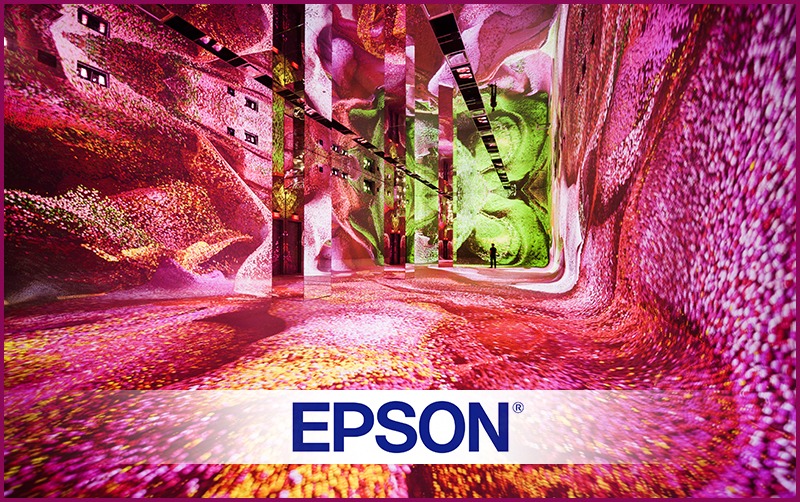
07 October 2026: DATALAND, founded by Refik Anadol and Efsun Erkılıç, opened at The Grand LA in Los Angeles on 20 June 2026. In a 30 September 2026 announcement, Epson detailed how 84 synchronized laser projectors power its largest gallery, using room-wide imagery to connect visitors with rainforest-inspired AI art.
The museum has five galleries across 25,000 square feet of public exhibition space. DATALAND describes itself as the world’s first Museum of AI Arts. Its opening exhibition, Machine Dreams: Rainforest, combines environmental data with audience interaction rather than presenting a fixed sequence of images.
How Epson laser projectors fill the Data Pavilion
Gallery A, the Data Pavilion, uses 84 Epson EB-PQ2220B laser projectors. Each carries a 20,000-lumen rating for white and colour brightness, although actual output varies with operating conditions. Epson specifies 3,840 × 2,160 on-screen resolution using its 4K Crystal Motion technology.
The installation takes projection beyond the single-screen setting of Epson’s 4K home projectors: dozens of units must align across walls, floors, ceilings and mirrored columns.
According to Epson, interchangeable lenses accommodate the gallery’s geometry, while camera-assisted software calibrates, aligns and edge-blends the projections. That coordination matters because mirrored surfaces can repeat imagery and expose mismatched edges. Anadol says Epson supplied projectors during the design phase so the studio could test reflections before completing the installation.
“Visitors often can’t tell where the architecture ends and the projected imagery begins, which allows for full immersion in the artwork,” Anadol said.
The gallery’s fixed architectural layout contrasts with portable AV display systems designed for shared spaces. Here, the room itself becomes the projection surface.
How rainforest data and visitors shape the artwork
DATALAND’s official exhibition description identifies Refik Anadol Studio’s Large Nature Model as the AI system behind the experience. It draws on ecological archives and live environmental feeds to generate changing imagery and sound. Epson says the exhibition uses live data from 16 rainforest locations.
The museum says the model combines datasets from research institutions and environmental organisations with material gathered through fieldwork and direct observation. Its Data Pavilion pairs projected imagery with a spatial soundscape and molecular scent compositions developed with L’Oréal Luxe. The experience draws on stored ecological records as well as changing environmental signals.
Gallery B offers another form of participation. Its Thinking Brush installation turns hand-drawing gestures into evolving imagery, while Fluid Pigments responds to body movement with shifting particles and forms. These stations let visitors influence the artwork directly, rather than simply watch it unfold.
Wearable biosensors register visitors’ heartbeat and movement, while spatial tracking lets their position influence the experience. The museum describes two interacting streams: environmental signals from rainforests and signals from people inside the galleries. Sound and scent accompany the projections, so audience participation affects more than the visual display.
DATALAND says it anonymizes visitor records by default. Visitors can choose to preserve their experience through Data.Token; otherwise, the museum says it automatically deletes the visit record after departure.
For specialists working in immersive display integration, DATALAND offers a concrete installation case: projection hardware must work with reflective architecture while the content changes in response to live inputs.


Sorry, the comment form is closed at this time.