


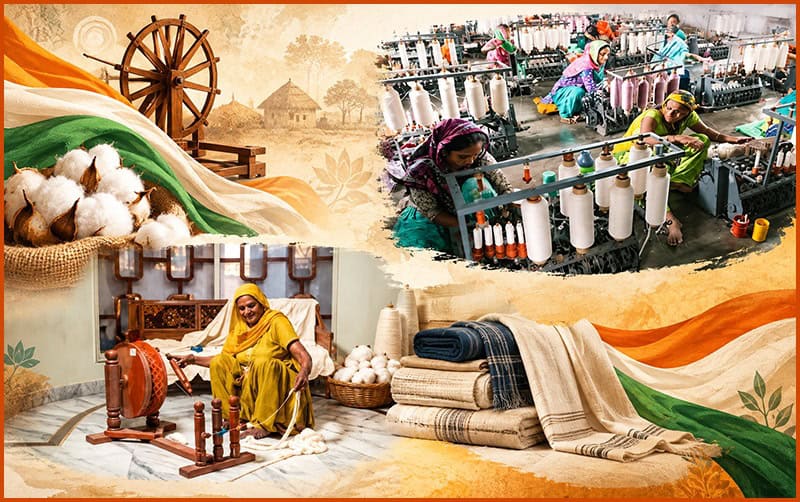
Khadi and Village Industries: New Designs and Artisan Support
12 October 2026: India’s Ministry of Micro, Small and Medium Enterprises outlined artisan support and design development in the Khadi and Village Industries sector in an update issued from New Delhi on 9 October 2026. The release covers wage measures and production upgrades aimed at strengthening rural livelihoods and widening markets for handmade textiles.
What distinguishes Khadi from other handloom fabrics?
Khadi combines hand-spun yarn with hand weaving. The ministry identifies hand spinning as the distinction between Khadi and other handloom fabrics. Its decentralised production model provides work for spinners and weavers while retaining traditional craft skills.
Designers can work with those methods without replacing them. Earlier coverage of the Aheli Khadi design programme describes hand block printing, embroidery and home-linen collections, illustrating how Khadi fabrics can serve different apparel and furnishing needs.
How Khadi and Village Industries support artisans
According to the ministry, women account for around 80% of approximately five lakh Khadi artisans. These figures refer specifically to Khadi artisans, rather than the entire workforce across village industries.
The Khadi and Village Industries Commission (KVIC) supports institutions through skill development, better tools, infrastructure and marketing. The update also notes increases in spinning and weaving wages from April 2025. Government assistance operates through Khadi Vikas Yojana, Gramodyog Vikas Yojana and PMEGP. Depending on the scheme, support includes finance, working capital, raw materials, training and toolkits. The release also lists digital payments and social security measures among the interventions.
New designs for clothing and lifestyle products
The ministry’s design update reports that the Centre of Excellence for Khadi at the National Institute of Fashion Technology (NIFT), Delhi, has developed 2,129 Khadi design collections across multiple categories.
It also lists 710 new products under Navyug Khadi and identifies Svadha as a wellness and yoga-wear collection. Denim, designer saris, bridal wear, shirts and trousers form part of Khadi’s wider product range.
These efforts build on earlier design promotion. Screen Print India’s Navyug Khadi fashion coverage describes clothing, accessories and home décor made by Khadi institutions, providing background to the current update.
Ponduru recognition and export opportunities
The ministry confirms geographical indication (GI) recognition for Ponduru Khadi and reports KVIC’s registration as an Export Promotion Council on the trade portal of the Consulate General of India in New York. It presents these steps as support for branding and international exposure, not evidence of increased export sales.
Naturally coloured cotton remains a research initiative
KVIC and ICAR-CIRCOT are exploring naturally coloured cotton varieties, with the aim of reducing water use, chemical pollution and energy consumption associated with conventional dyeing.
The ministry reports completed modernisation at two Central Sliver Plants, in Karnataka and Kerala. It says solar energy meets 50% of the Karnataka plant’s requirement, while wind power remains under exploration. Other proposed measures include technology-based Common Facility Centres for village industries clusters.
For textile processors, earlier reporting on Karuangan’s natural-dye enterprise provides a practical example of technical training connected to rural dyeing and printing work.



Sorry, the comment form is closed at this time.