


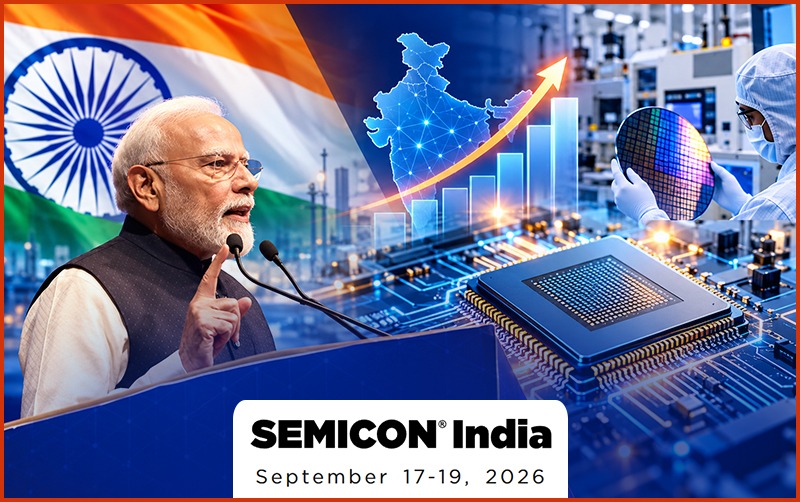
SEMICON India 2026: Modi Outlines USD 13.5 Billion Chip Plan
10 October 2026: Prime Minister Narendra Modi inaugurated SEMICON India 2026 at Yashobhoomi in New Delhi on 17 September 2026, outlining India’s move towards commercial semiconductor production. His address linked new production lines with a USD 13.5 billion second-phase mission and efforts to develop the suppliers and engineering talent needed for chip manufacturing.
The fifth edition ran from 17-19 September 2026. Modi invited international companies to invest across chip design, equipment and materials, framing the programme around technological self-reliance and the Viksit Bharat goal. He also asked industry leaders to support research in India.
Modi cited India’s economic performance as the backdrop to these plans. The Ministry of Statistics and Programme Implementation estimated real GDP growth of 7.8% year-on-year in April-June 2026, the first quarter of financial year 2026-27. This was an economy-wide measure, not a semiconductor-sector growth figure.
Commercial production at Mohali and Surat
The government said Modi virtually inaugurated commercial production lines at CDIL Semiconductor in Mohali for discrete devices and Suchi Semicon in Surat for semiconductor packaging. These activities represent different parts of chip production; the announcement did not mean that every approved Indian wafer fabrication project had started operating.
In the same update, Tata Electronics described construction of its Dholera wafer fab and Jagiroad assembly and testing facility as on track. Modi said chips from Indian plants had begun reaching domestic and international customers, although the Prime Minister’s Office summary did not provide shipment totals.
What does SEMICON India 2026’s second-phase roadmap cover?
Modi described the second phase of the semiconductor mission as a USD 13.5 billion programme. The India Semiconductor Mission’s official website records Cabinet approval of Semicon 2.0 on 15 July 2026.
The mission identifies six areas of support:
- Chip design.
- Equipment and materials.
- Additional semiconductor fabrication plants.
- Advanced packaging.
- Applied research and development.
- Talent development.
Screen Print India’s earlier coverage of India Semiconductor Mission 2.0 provides the budget context for its equipment, materials and training priorities. The programme’s funding and support should not be confused with investment already spent or facilities already completed.
Supplier opportunities beyond chip factories
Modi urged manufacturers of equipment, chemicals, gases and specialised materials to consider opportunities in India. In the Prime Minister’s Office account of his address, he linked these opportunities to approved semiconductor projects and the need for a domestic supply chain.
The inauguration briefing also recorded ASML’s lithography partnership with Tata Electronics. Screen Print India’s report on ASML’s Tata fab support explains the equipment context. Modi also discussed artificial intelligence and silicon photonics, alongside the memory and heat-management demands of high-performance computing.
Training and reliable power
Modi said 70,000 engineering students had received chip-design training against a target of 100,000. These are reported training numbers, not a count of people employed in semiconductor factories. The wider workforce discussion includes the India Semiconductor Academy proposal, which addresses practical training beyond design education.
He also stressed uninterrupted electricity for manufacturing plants and the power demands of AI data centres. Renewable energy and research formed part of his argument for supporting future semiconductor investment. His invitation to industry covered local research and the suppliers needed to keep production facilities running.


Sorry, the comment form is closed at this time.