


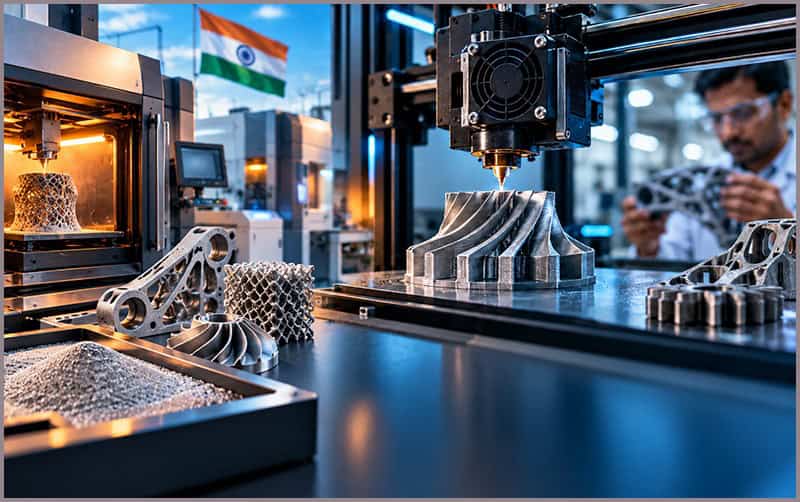
3D Printing in India: Policy Push Meets Production Tests
05 October 2026: India’s Ministry of Electronics and Information Technology advanced its 3D printing agenda at the National Additive Manufacturing Symposium on 13 March 2026 in New Delhi. The ministry released a sector report and discussed domestic equipment, materials and defence adoption, placing industrial capability at the centre of its policy push.
What supports 3D printing in India?
The Ministry of Electronics and Information Technology (MeitY) launched its national additive manufacturing strategy on 24 February 2022. It sought to develop Indian capabilities in materials, machines, processes and software, alongside finished products.
The original goals included 50 India-specific technologies, 500 products, 100 startups and 100,000 skilled personnel across ten manufacturing sectors. These remain launch targets in the cited announcement, not verified achievements. Screen Print India’s earlier coverage of the national additive manufacturing strategy provides that policy background.
At the 2026 symposium, held at Scope Convention Centre, MeitY released the India and Global Additive Manufacturing Ecosystem 2026 report. Panels covered NSAM 2.0 policy initiatives, defence adoption, research centres and collaboration across ministries. Discussion of NSAM 2.0 does not, by itself, establish that a revised strategy has completed formal approval.
Research centres and workforce training
MeitY reported seven dedicated centres on 20 June 2024. That is a dated government count, rather than a newly confirmed 2026 total. The ministry described work involving optical chip packaging, electronics components, medical devices, food printing and renewable-energy products.
Healthcare offers a concrete example of skills development. Screen Print India’s 1 October 2026 report on AMTZ medical 3D printing, citing MeitY’s Annual Report 2025-26, said the Visakhapatnam centre had trained more than 2,400 personnel. The reported training covered design, prototyping and testing as well as printing.
That distinction matters for manufacturers: a training programme can build product-development skills, but its attendance total does not establish how many products have reached commercial production.
Production parts still need testing
Defence maintenance illustrates both the opportunity and the limits. The Tribune reported on 19 August 2026 that an Indian Air Force Base Repair Depot was printing rubber replacement parts for Russian-origin aircraft, reducing waits for some imported spares. The report describes producing single parts or small batches from reusable digital files, avoiding the dedicated mould needed for conventional injection or compression moulding.
Screen Print India’s coverage of IAF 3D-printed aircraft spares explains the same application. Depot teams test flexibility, sealing performance and durability before using a part on an aircraft. Producing a shape is only one step; proving that the component can perform its intended job remains necessary.
How should readers interpret market forecasts?
A 3 March 2026 Equitymaster commentary estimated India’s 3D printing market at approximately USD 850 million in 2026 and projected USD 4.3 billion by 2033. India’s expansion will ultimately need evidence of repeatable, commercially viable production. Policy targets, research activity and training totals show different forms of progress; they should not substitute for evidence that manufacturers can deliver qualified parts at a competitive cost.


Sorry, the comment form is closed at this time.