



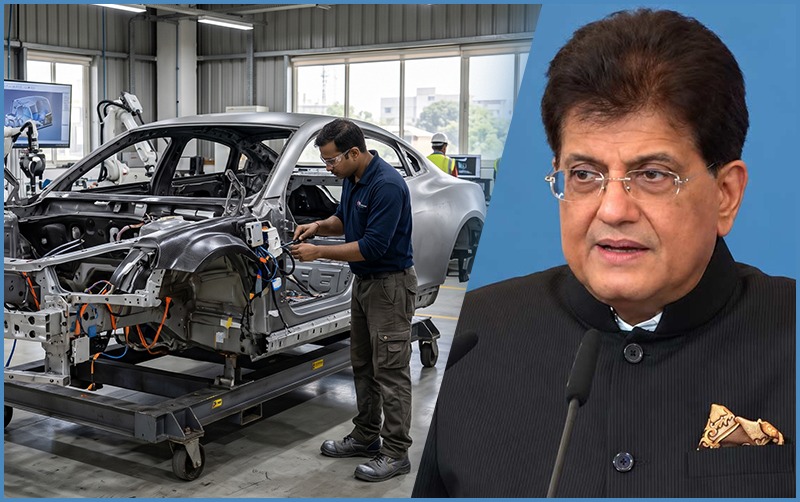
European Carmakers Explore Manufacturing Opportunities in India
29 October 2026: European carmakers are exploring manufacturing opportunities in India, Commerce and Industry Minister Piyush Goyal said in Berlin on 23 October 2026. His remarks, reported by PTI, point to possible investment and supplier opportunities, but the report did not identify new automotive projects, investment amounts or commissioning dates.
India’s commerce ministry confirmed that Goyal’s Berlin engagements concluded on 23 October. They included meetings with representatives of Volkswagen, Siemens Healthineers and Bertelsmann, plus research discussions covering microelectronics, smart manufacturing and battery technologies. The ministry also reported sectoral roundtables between Indian businesses and German industry representatives to discuss potential business collaboration.
European carmakers assess new production options
Volkswagen, Mercedes-Benz, BMW, Audi and Škoda already have operations in India, PTI reported. Goyal argued that high costs and regulatory requirements in Europe could encourage manufacturers to consider production in trusted partner countries.
The workforce dimension extends beyond proposed factories. PTI also reported Goyal’s remarks on German demand for trained technical workers and the importance of language preparation. For suppliers assessing expansion at home, workforce training in India remains a related production consideration.
India already has a substantial vehicle-export base. The Society of Indian Automobile Manufacturers reported passenger-vehicle exports of 9.05 lakh units, or 905,000 vehicles, in April 2025–March 2026, up 17.5% year on year. This provides a dated benchmark for Goyal’s rounded reference to approximately one million car exports.
German investment announcements differ from FDI inflows
PTI quoted Indian Ambassador to Germany Ajit Gupte as saying German companies had announced USD 7.4 billion in investments over the preceding two-and-a-half years.
Report identified interest in precision engineering, aerospace, defence, shipbuilding, healthcare, pharmaceuticals and research and development. It also reported that more than 2,000 German companies operate in India, with German FDI of USD 495 million in 2025-26 and cumulative inflows of USD 15.84 billion between April 2000 and June 2026.
India-EU trade agreement awaits formal approvals
The European Commission says negotiations concluded in January 2026 and it submitted proposals for signature in September. Signature and the required approval and ratification steps must precede entry into force; prospective trade benefits should not be described as already available. PTI reported expectations of signature by the end of 2026 and possible entry into force in the first quarter of 2027, rather than a confirmed implementation date.
The EU agreement is also distinct from India’s trade agreement with EFTA, the European Free Trade Association. Businesses should distinguish the two when assessing market access.
Where industrial printing could fit
Automotive manufacturing offers significant opportunities for decorative and functional printing applications, including interior trim, control buttons, switches, displays and aluminium emblems. Another important technology is film insert moulding, in which reverse-printed plastic films are formed and subsequently back-injected with molten plastic to produce durable, decorated and functional automotive components.
These applications present promising opportunities for India’s industrial printing sector, particularly for suppliers of screen printing technologies, specialty inks, functional coatings and advanced materials. However, discussions in Berlin do not necessarily translate into immediate printing orders. Actual business opportunities will depend on confirmed manufacturing investments, specific production requirements and purchasing decisions rather than expressions of investment interest alone.
Sorry, the comment form is closed at this time.