



Piyush Goyal Urges Auto-Component Firms to Build Global Supply Chains
03 September 2026: India auto-component industry leaders have been urged to build manufacturing operations abroad, localise supply chains and use new trade agreements to reach larger markets. Commerce and Industry Minister Piyush Goyal set out the priorities at ACMA’s 66th Annual Session in New Delhi on September 2, 2026, while also calling for AI-based quality control and more work on automotive technical textiles.
India auto-component industry urged to think globally
In the official PIB account of the ACMA address, Goyal asked component makers to look beyond exporting from India. He encouraged companies to establish facilities in international markets while retaining domestic production and employment.
The stated objective is a more resilient operating model: overseas plants can serve local customers, while Indian facilities continue to supply domestic and export demand. The address did not include investment values, named projects or a timetable, so it should be read as policy direction rather than a confirmed expansion programme.
Trade agreements and supply-chain localisation
Goyal pointed to India’s trade agreements as market-access tools for auto suppliers. The India-UK CETA took effect in July 2026, and the minister also referred to agreements with New Zealand and Oman plus negotiations with the United States and European Union.
For component manufacturers, tariff access is only one part of the decision. Buyers still assess delivery reliability, certification, traceability, localisation and service coverage. The minister’s call to reduce import dependence also covered critical minerals, magnets and specialised materials, but the release did not quantify current dependency or supply gaps.
AI quality control moves onto the agenda
The address asked industry to pursue AI-based quality checks and predictive maintenance. In practice, that means using production data to detect defects, monitor equipment and flag process drift while keeping engineers responsible for standards and final release decisions. SPI’s guide to practical AI in printing makes the same distinction between narrow automation and operator judgement.
No specific platform, factory deployment or performance result was named at the ACMA session. Companies evaluating these systems still need baseline defect data, clear acceptance limits and independent measurement before claiming savings.
Automotive technical textiles offer a cross-sector opening
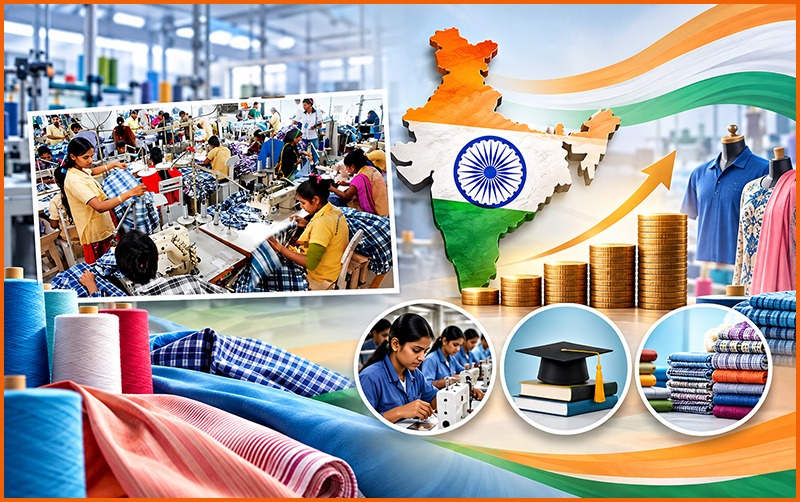
Goyal identified automotive technical textiles as an area for further research and development. These materials can serve seating, insulation, filtration, safety and interior applications, bringing textile engineering into vehicle supply chains. India’s technical textiles growth programme provides broader context for that opportunity.
He also called for closer work between industry and academia and stronger product branding. For suppliers, the commercial test will be qualification by vehicle makers, repeatable performance and scale, not the number of prototypes announced.
Growth backdrop for the policy push
The minister linked the sector’s opportunity to India’s wider economy and cited 7.8% growth in the first quarter of fiscal 2026-27. SPI’s India Q1 GDP report notes that the figure is an official estimate and that manufacturers still face external risks.
Goyal also proposed a roundtable involving ACMA, Indian missions abroad and Invest India. A useful follow-up would be a public action list covering markets, financing, technology gaps and domestic supply-chain priorities.
What should suppliers watch next ?
- Named overseas investments and their relationship to Indian capacity.
- Customer wins tied to CETA or other trade agreements.
- Measured AI quality and maintenance deployments.
- New automotive technical-textile products that pass OEM qualification.
The speech sets a direction for the sector, but execution will depend on company investment, customer qualification and measurable supply-chain gains.
Sorry, the comment form is closed at this time.