


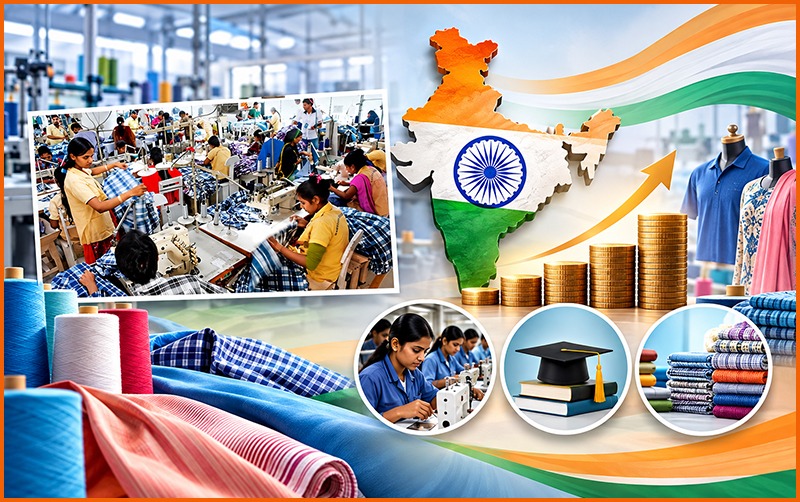
India weighs INR 25,000-crore Samarth 2.0 skilling plan
23 October 2026: India’s government is considering an INR 25,000-crore, five-year outlay for Samarth 2.0, according to a Mint report from New Delhi on 19 October 2026. The proposal seeks to prepare textile and garment workers for changing factory requirements, but the reported funding still awaits final Cabinet approval.
The focus on factory-ready training follows wider industry debate about textile workforce skill gaps, including how manufacturers can adapt to new technology while retaining experienced workers.
What does Samarth 2.0 propose?
The government announced Samarth 2.0 in the Union Budget 2026–27. In its 1 February 2026 Budget statement, the Ministry of Textiles described an upgraded skilling programme built around closer collaboration with industry and academic institutions. Its stated purpose was to prepare industry-ready workers across the textile value chain.
That announcement established the programme’s policy direction. INR 25,000-crore figure comes from the subsequent Mint report, which cited two unnamed people aware of the matter. Mint reported that the Expenditure Finance Committee had examined the proposal and that it could next go before the Cabinet. The newspaper said its questions to the government remained unanswered at publication.
Official outline targets 15 lakh trainees
The ministry’s 13 March 2026 consultation release stated that Samarth 2.0 aimed to skill 15 lakh individuals over five years. Issued after a Western Zone meeting in Mumbai, it described training, reskilling and upskilling aligned with technological and industry requirements.
This is a planned training target, not a count of people already trained or jobs created. The October funding report did not specify a revised training target.
The ministry continued consultations with states and industry after the Budget. Its 7 April 2026 stakeholder meeting in New Delhi brought together business representatives and academia to discuss implementation and operational challenges, with feedback intended to inform the design of forthcoming schemes.
Industry participation is not a new idea. CMAI’s Bhiwandi training initiative, reported in October 2025, focused on training linked to garment manufacturers’ needs.
What should textile employers watch next?
For manufacturers, the next useful details will be the approved funding, implementation timetable and rules for participation. Until those details emerge, businesses should not assume that the reported outlay creates an immediate entitlement to training support.
The available announcements do not establish specific courses in textile printing, embroidery or automated production systems. Those subjects may be relevant to employers, but presenting them as confirmed programme components would go beyond the evidence.
Earlier ATDC industry training discussions also connected workforce capability with machinery investment and garment export ambitions. For factories, practical competence and employment outcomes will matter alongside the number of people enrolled.
FAQs
Has the INR 25,000-crore funding been approved?
The 19 October 2026 report described the funding as under consideration, with final Cabinet approval still pending. It should not be treated as an approved allocation or money already spent.
How many people does the official outline aim to train?
The Ministry of Textiles’ March 2026 outline specified 15 lakh individuals over five years.

Sorry, the comment form is closed at this time.