


MasterCut Uses Direct-to-Object Inkjet Printing for 20,000+ SKUs
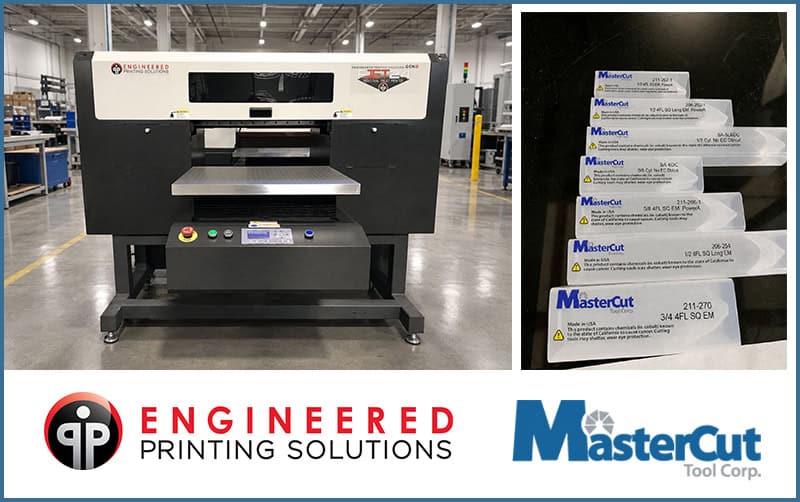
22 January 2026: In a case study first published in July/August 2026, Engineered Printing Solutions detailed how MasterCut Tool in Florida uses direct-to-object inkjet printing to decorate rigid plastic cases across more than 20,000 active SKUs. A two-tier multi-pass and single-pass setup lets the manufacturer route jobs by volume, cut label handling and avoid SKU-specific print tooling.
Why does MasterCut use direct-to-object inkjet printing ?
Mastercut Tool Corp. has manufactured carbide cutting tools in Florida since 1985. Its range includes end mills, drills and burs, and each product ships in a case carrying its own part number, description and regulatory warning.
That product mix creates a decoration problem. According to the official EPS case study, no two cases share the same artwork. Pressure-sensitive labels add material, stocking and application work, while pad and screen printing require a plate, cliché or screen for every design. Across 20,000-plus SKUs, that tooling and the related changeovers become costly to manage.
How does the two-tier inkjet setup work ?
MasterCut runs several multi-pass inkjet systems beside a single-pass platform. The multi-pass machines handle short and medium runs, where operators need frequent artwork changes and flexible scheduling. The single-pass system takes continuous, higher-volume work, where line speed has more influence on unit cost.
Both tiers read the same digital artwork files. Jobs can move between them without separate plates or screens, so the production team can choose a route based on order size rather than forcing every SKU through one machine. EPS describes this as a shared workflow with two print tiers.
What changed on the packaging line ?
EPS says MasterCut removed pressure-sensitive labels from the line and now introduces a new SKU by adding or changing an artwork file. The setup eliminates SKU-specific print tooling and the label application step. EPS also says matched pretreatment and UV-curable inks can produce durable markings on polypropylene and other moulded polymers, though the case study gives no measured abrasion or chemical-resistance results for MasterCut.
The project also fits the wider shift toward integrated DTO production covered in Screen Print India’s report on DTO automation. For high-mix manufacturers, the practical gain is job routing: multi-pass equipment keeps short runs economical, while single-pass equipment handles the repeat volume.
What does the case study prove ?
MasterCut’s arrangement shows how one digital workflow can serve both the long tail of specialised products and frequently ordered lines. It does not establish a universal saving, since EPS published no investment, payback, output or before-and-after cost figures. The case does show that removing physical print tooling makes a 20,000-SKU packaging programme easier to schedule and expand.
www.epsvt.com
Sorry, the comment form is closed at this time.