



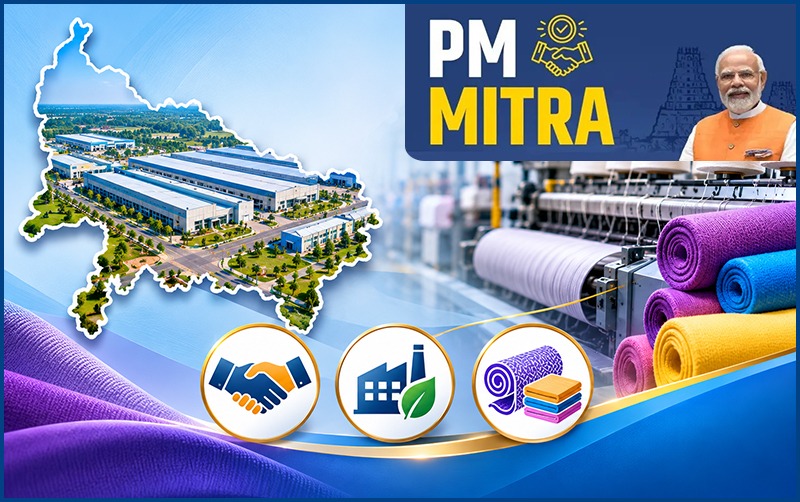
Uttar Pradesh names Ramky preferred bidder for PM MITRA textile park
03 November 2026: Uttar Pradesh’s Cabinet approved Ramky Infrastructure Ltd as the preferred bidder for a 1,000-acre PM MITRA textile park on the Lucknow-Hardoi border on 27 October 2026. The proposed INR 1,947-crore development would provide shared manufacturing infrastructure, with the state government projecting around one lakh direct and indirect jobs.
The Cabinet accepted the single bid received for the master developer. This is a developer-selection milestone for a project previously covered at the Lucknow park planning stage, not an announcement that the textile park has opened.
How will the PM MITRA textile park be funded?
PM MITRA Park Uttar Pradesh Ltd will implement the project through a public-private partnership. The state government owns 51% of this special purpose vehicle and the Centre 49%. PTI reported a five-year construction period under the design, build, finance, operate and transfer model.
The Ministry of Textiles’ revised funding guidelines provide development capital support at 30% of project cost, capped at INR 500 crore for a greenfield park. Release of this support depends on project progress and matching contributions; the ceiling does not mean INR 500 crore has already been disbursed.
The same guidelines set an initial 25-year concession for master-developer-led greenfield parks, with an additional 25 years conditional on meeting phase-II benchmarks.
Which facilities does the park proposal include?
Planned facilities include ready-to-use factory sheds, internal roads, electricity distribution, warehousing and a logistics hub. PTI also lists worker accommodation, a health centre and a skill development institute.
A proposed common effluent treatment plant would treat and recycle industrial wastewater to zero-liquid-discharge norms. These are planned facilities, not services already available to manufacturers.
The integrated-site approach forms part of the seven-state PM MITRA programme. The Ministry of Textiles describes its purpose as providing infrastructure for the full textile value chain.
What changes for textile manufacturers?
The state expects the park to attract private investment and benefit weavers, garment manufacturers and exporters. Its employment estimate remains a projection tied to future development, rather than a count of jobs already created.
Screen Print India’s PM MITRA investment discussions coverage provides background on the programme’s engagement with textile companies and infrastructure developers.
The Cabinet separately cleared seven drinking-water and sewerage expenditure proposals for Lucknow and Varanasi under AMRUT 2.0. Those civic projects are not part of the textile park’s INR 1,947-crore development cost.


Sorry, the comment form is closed at this time.