


IIT Madras Team 3D Prints Musical Instruments in Plastic
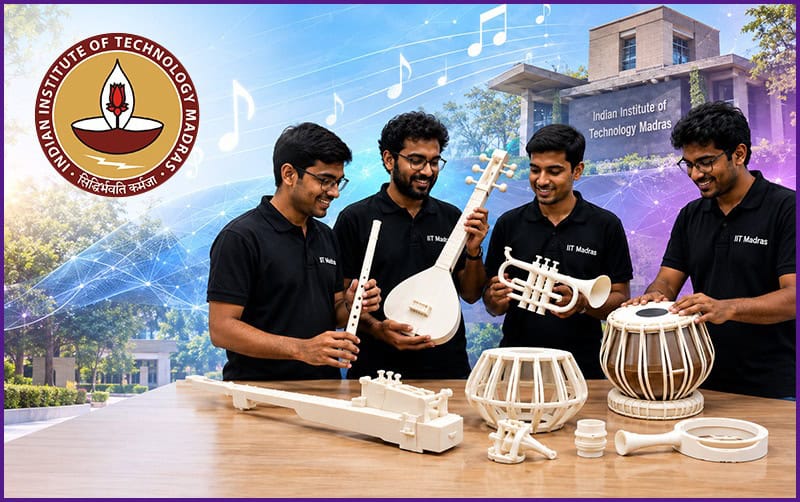
04 September 2026: IIT Madras 3D-printed musical instruments are testing whether digital modelling and plastic fabrication can make violins, ukuleles and Indian string instruments easier to produce. Professor Ramanathan Muthuganapathy and his students have built playable prototypes while studying how body shape, wall thickness, internal structure and material affect tone.
How IIT Madras 3D-printed musical instruments are made
The work combines computer-aided design with additive manufacturing. A digital model defines the instrument body, which is then printed in plastic rather than carved from wood. The approach lets the team alter geometry between prototypes without making a new mould or repeating every manual construction step.
The CSR Journal report says the group has produced violins and ukuleles and is adapting the process to Indian instruments. IIT Madras lists Muthuganapathy as a professor in its Department of Engineering Design, where his research covers geometric modelling and computer graphics.
Can a plastic instrument sound like wood ?
The prototypes are playable, but the work does not prove that plastic instruments match the acoustic character of established wooden models. The report says the team is tuning design variables and comparing results, while recognising the warmth associated with wood as a difficult reference point. No controlled acoustic measurements, production price or commercial launch date were published.
That distinction matters. A printed prototype can demonstrate shape, assembly and playability without establishing long-term durability, tonal consistency or acceptance by professional musicians. Those questions need repeatable tests and feedback from players.
Why additive manufacturing suits instrument experiments
3D printing is useful for low-volume objects whose dimensions may change often. The same flexibility supports design-led fabrication with recycled plastic and small-batch replacement parts. In each case, the economics depend on material, print time, finishing and validation rather than the printer alone.
The IIT project also sits within wider Indian work on digital manufacturing. A separate IIT Tirupati 3D-printing programme has examined machine-learning methods for detecting manufacturing defects. Market forecasts point to broader adoption, although the future value of the 3D-printing market remains a research estimate.
What could make the instruments more accessible ?
Digital files can be reproduced close to the user and adjusted for size or ergonomics. That could support teaching instruments, custom fittings and replacement components. Real accessibility, however, depends on total cost, availability of printers and materials, finishing skill, repair options and whether musicians accept the sound and feel.
FAQs
Which instruments has the IIT Madras team printed ?
The cited report names violins and ukuleles and says the team is exploring Indian string-instrument designs.
Are the instruments commercially available ?
No commercial availability, price or production timetable was confirmed in the sources reviewed.


Sorry, the comment form is closed at this time.