


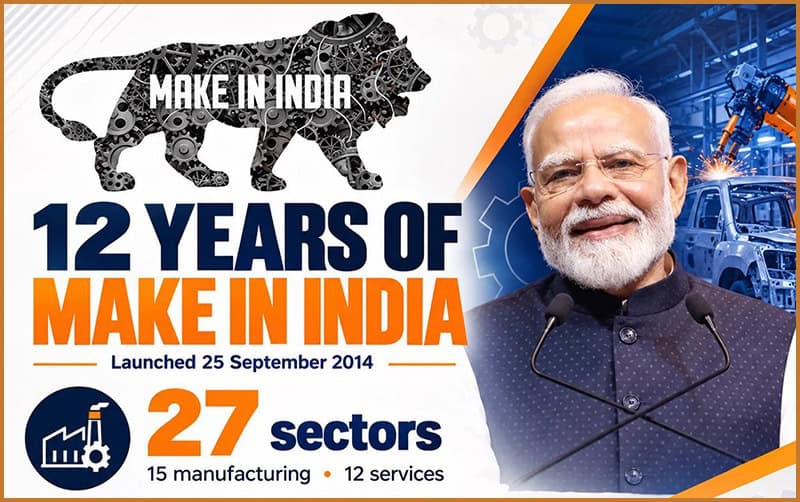
Make in India Turns 12 as Manufacturing Priorities Expand
29 September 2026: Prime Minister Narendra Modi marked 12 years of Make in India on 25 September 2026, citing growth in domestic manufacturing, investment and exports across India. The anniversary puts attention on the next stage of industrial development: making more components and machinery locally, alongside finished goods.
In his anniversary message, Modi pointed to increased production, investment and exports, describing a change visible across sectors. The initiative began on 25 September 2014 with the stated ambition of making India a global manufacturing, design and innovation hub.
Make in India: What has changed in manufacturing?
A government backgrounder issued on 24 September 2026 reports production gains across electronics, automobiles, pharmaceuticals, steel, railways and defence. It also describes efforts to expand domestic capabilities in industrial inputs and production equipment. These are government-reported achievements, rather than an independent assessment of the programme’s impact.
According to the backgrounder, electronics production rose from approximately INR 1.9 lakh crore in 2014-15 to INR 13.11 lakh crore in 2025–26, nearly sevenfold. Screen Print India’s earlier coverage of the electronics sector’s ten-year progress provides historical context; those earlier figures cover a different reporting period.
The latest backgrounder places mobile-phone production at approximately INR 6.3 lakh crore in 2025-26, against INR 18,900 crore in 2014-15. Defence production reached INR 1.78 lakh crore in 2025-26, compared with INR 46,429 crore in 2014-15, according to the same source. That puts its reported value at nearly four times the earlier level.
Why components and machinery matter
The government’s account extends beyond finished products to the parts, materials and machinery used to make them. This distinction matters: producing a final product and developing its domestic supply chain are separate measures of industrial capability.
For printing businesses, the backgrounder includes a directly relevant comparison. Citing Ministry of Heavy Industries figures, it reports that printing-machinery production increased from INR 12,678 crore in 2019-20 to INR 29,716 crore in 2024-25. Textile-machinery production rose from INR 5,355 crore to INR 10,461 crore over the same period.
In electronics, the policy direction includes support for components and production equipment. Earlier coverage of the Electronics Components Manufacturing Scheme explains the intended move towards deeper domestic manufacturing rather than dependence on final assembly alone.
Investment support and the next stage
The backgrounder identifies Production Linked Incentive schemes, PM GatiShakti, the National Single Window System and the India Industrial Land Bank as supporting measures. Their functions differ: production incentives sit alongside infrastructure planning, approval services and information on industrial land.
For textile readers, the earlier PM MITRA textile parks announcement offers related context on planned industrial infrastructure. An announcement, however, does not establish that every park or proposed investment is operating.
Semiconductors remain another policy priority, with the government describing support for design, manufacturing and advanced packaging. As Make in India enters its thirteenth year, the stated emphasis is on domestic technology, skills and supply chains. Assessing that progress requires keeping announced support, installed capacity and actual production distinct.

Sorry, the comment form is closed at this time.