



Ricoh and ETRIA plan Circular New printer production in 2027
28 October 2026: Ricoh and ETRIA announced Circular New in Tokyo on 6 October 2026, outlining plans to use recovered components in newly manufactured A3 monochrome multifunction printers. Production in Japan and France is scheduled for the first half of 2027, aiming to reduce demand for newly sourced materials and shorten transport routes.
The first models will be the RICOH IM 6010/4510/3510/2510 series, supplied in Japan and Europe. Initial circular production will take place at ETRIA Manufacturing Japan’s Gotemba site and ETRIA Manufacturing France, alongside existing centralised production in Thailand and China.
How Circular New will reuse components
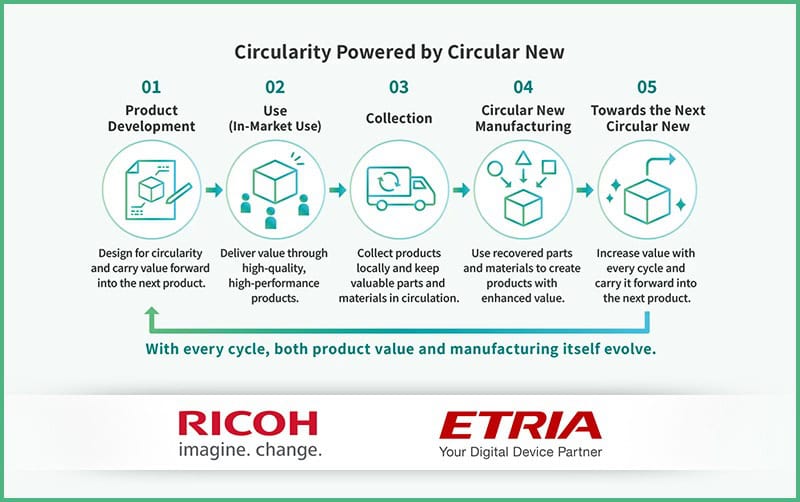
Circular New connects product planning and design with manufacturing, use, collection and reuse. Ricoh says ETRIA designs frames and components for use across different models and generations, extends component lifespans and makes equipment easier to disassemble and repair.
The approach applies circular economy design principles by treating equipment already in use as a source of parts for future machines. Digital information about component condition, combined with sorting and quality checks, will help determine which recovered parts can enter new production.
Ricoh distinguishes this approach from restoring a used machine for resale. Circular New will incorporate recovered parts and materials into newly manufactured products in its current lineup, rather than simply return an older device to its original condition.
What do the material and carbon figures measure?
According to Ricoh, localised circular production is designed to reduce the proportion of newly sourced materials from approximately 76% to as low as 21%. The calculation measures material inputs by weight for newly manufactured A3 laser MFPs; the result depends on how many recovered components the manufacturer can use. The figures describe newly sourced inputs, not a separate recycled-material content specification.
The company also calculates a potential product carbon-footprint reduction of up to 25% for a locally produced RICOH IM 6010 compared with the same model manufactured at designated Asian sites. This is a life-cycle greenhouse-gas comparison, expressed in carbon-dioxide equivalents. The saving varies with recovered-component use and transport distances, so it should not be read as a guaranteed reduction for every device.
What will printer buyers receive?
Ricoh says centrally manufactured and locally produced machines will sit within the same product lineup, with consistent quality, functionality and warranty. Regional collection and production are also intended to reduce exposure to logistics disruption, geopolitical risks and volatile resource prices; these are expected benefits, not reported operating results.
The initiative extends Ricoh’s work on resource conservation, which Screen Print India has covered in its reporting on Ricoh’s production-print sustainability. The first Circular New application, however, concerns A3 monochrome office MFPs.
Part of Ricoh’s wider resource targets
Ricoh’s resource circulation policy sets group targets to bring newly sourced material inputs to 60% or less by 2030 and 12% or less by 2050. These wider goals are separate from the model-specific figures announced for Circular New.
The company also links the initiative to its March 2026 management strategy, which targets a 30% engine market share for ETRIA by fiscal 2030. Local component recovery is therefore part of its manufacturing growth plan as well as its environmental programme.

Sorry, the comment form is closed at this time.